Thursday, November 4, 2021

Thanksgiving Activities In Your Classroom

 
The Spirit of Thanksgiving in the Classroom

Ways to Include Thanksgiving Into Your Classroom

Thanksgiving is coming and here are some of the fun and thoughtful ways to bring in holidays into your classroom that your students will enjoy.

One of the most engaging ways to learn at school, for both teachers and students, is celebrating holidays in the classroom. The month of November is short due to the holidays coming up, which also creates a busy time at school and home. Yet you want to make this time fun and academic for your students.

This is a great time to teach gratitude, kindness, friendship, and community. I have attached an activity you can do with your students. Click on this link if you are wanting Thanksgiving Classroom Activities.


Do this side whole group. Have students discuss in groups what each of these words means. Then discuss ways they can and do show each of these qualities. Write some of these on the board. Then give them time to fill out the graphic organizer.


You can print the pages front to back or on separate pages. You have 2 choices for printing on the backside. Your students can draw and label or draw and write. Allow them time to do this.

If you are wanting to study some of the histories behind Thanksgiving you can do a webquest. Scholastic has several good activities to choose from. Click on the link.

Host a canned/boxed food drive and donate the food items to the neighborhood Food Bank.

Do an acrostic poem using the letters in the word Turkey.

Brainstorm words that begin with the sound of each letter in Thanksgiving.

Have some Kindergarten Math fun with this packet!


What about FAll themed Picture Prompts for those 1st and 2nd graders??


There is so much more you can do with your students. Thank you for following me and reading my newsletters.

May you have a safe and blessed Thanksgiving!

Froggy About Teaching


Saturday, October 2, 2021

October Seasonal Products and Sale


I just love the Fall season, the changes in nature, and the holidays it brings with it! This is also a time I like bringing into the classroom the same love and appreciation for this season. 

I want to share with you the seasonal products that I have in my Amped Up Learning store because we will be having a Halloween Sale, October 4-6. Everything will be 20% percent off, and you can take an additional 5% off by using the code: Spooky when you check out.

Click on the pictures to check them out!


If you are needing anything, everything in my store is on sale at a 20% discount. You can get an extra 5% off simply by using the code: Spooky. October 4-6. 
Happy Shopping
Froggy About Teaching

#Halloweenresources #Halloweenactivities #Halloweenfun #Halloweensale #AmpedUpLearningHalloween

Friday, September 10, 2021

Young Learners Becoming Fluent Readers

Early Childhood Literacy

There are so many different factors that influence a young child's ability to learn to read. Educators want to build a firm foundation with these young children so that later they become fluent readers.

The New England Primer was the first textbook that was used to teach children to read in the American Colonies. The reading instruction included teaching the alphabet, consonants, and vowels.

Now let’s skip ahead and look at more recent times. In 2002, The National Early Literacy Panel was created to look at the scientific research conducted on the early literacy skills in children ages 0-5. 

    A key finding was made that strong “reading and writing skills that are developed in the years from birth to age 5 have a clear and consistently strong relationship with later conventional literacy skills.”

Factors That Strengthen Later Literacy

The NELP concluded that there are 7 factors that strengthen later literacy regardless of certain conditions such as IQ or SES.

• alphabet knowledge

• phonological awareness

• rapid automatic naming (RAN) of letters or digits

 • RAN of objects or colors

• writing or writing name

If you are interested in reading the results of this study go to: 

DEVELOPING EARLY LITERACY: REPORT OF THE NATIONAL EARLY LITERACY PANEL

·     I’ll begin by addressing alphabet knowledge.

Alphabet Knowledge

Alphabet Knowledge is the knowledge of individual letters, sounds, and letter shapes. It is:

·       Knowing each letter in conventional print has an uppercase and lowercase.

     Letter recognition and discrimination

·       knowing letter names

·       knowing letter shapes

·       knowing letter sounds

·       knowing that letters and sounds form written words

We can definitely see how essential these skills are to the early part of learning to read.

These are skills that are taught in PreKinder and in Kindergarten. PreKinder is not a required grade level so not every child attends. Kindergarten is not a full day in every district so some children have limited exposure to these skills.

 So, when these little ones come to us in PreK, in Kindergarten, and even in first grade we don't know how much of this they have had.  This creates an urgent need to provide direct instruction and to give many varied opportunities to master these literacy skills.

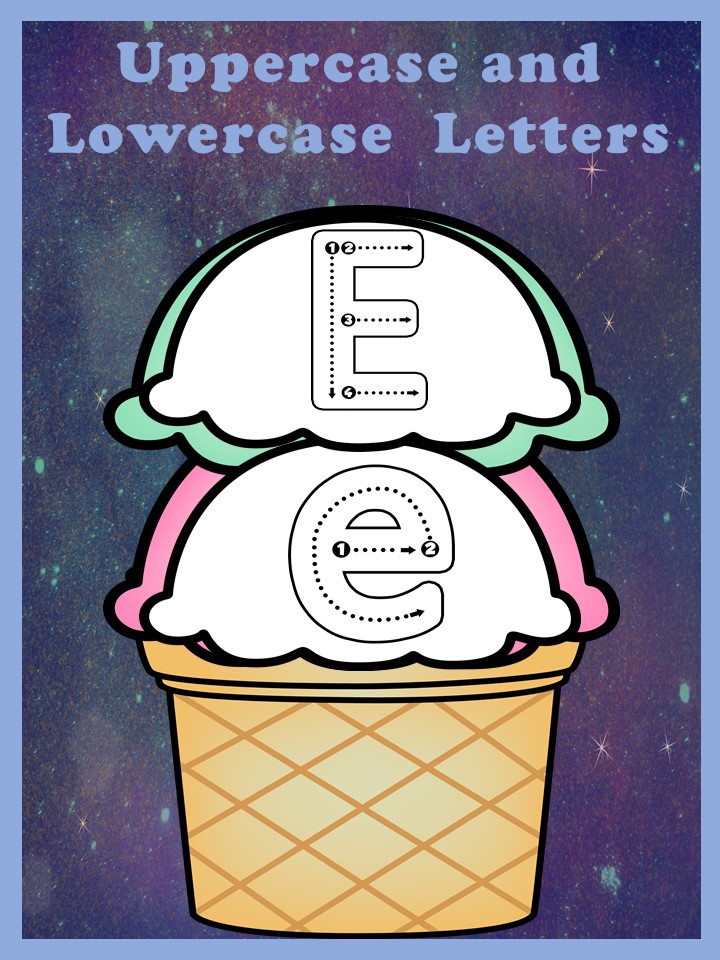
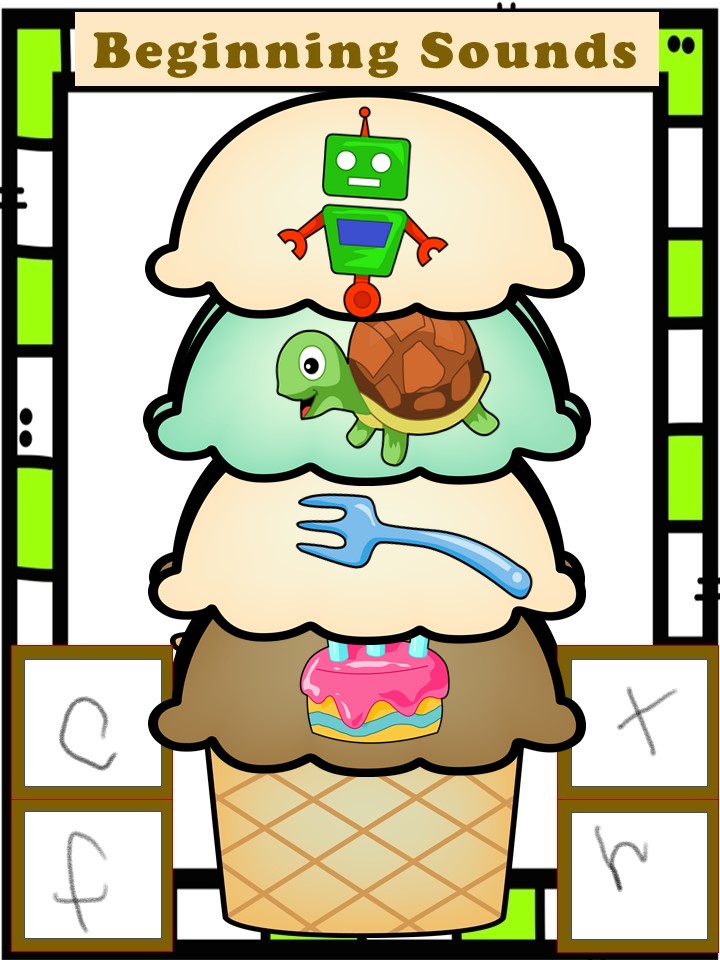
This packet is a way you can help your students become masters of letter formation, letter recognition of uppercase and lowercase letters, and make the connections between letters and sounds. They will get to practice letter formation by tracing letters. They will match the beginning sound of a picture to either lowercase letters or uppercase letters. This resource uses an approach that is appealing to students of building ice cream cones with scoops of letters and pictures.


This is a fun literacy center that will give your students hands-on practice with the recognition of letters and sounds! What better fun can they get than these ice cream-themed activities. This is a phonological resource that will help students to make connections between letter recognition and letter sounds.

This packet contains 3 sets of activities. This will allow you to differentiate for your students with these activities. 

Letter Trace for each uppercase and lowercase letter.

Uppercase Mat    

        Print on cardstock and laminate.  
        Velcro on the scoop.                                                                
                                                      Print on cardstock and
                                                      laminte. Cut out scoops
                                                      and velcro on the back.


 Letter Match for lowercase-uppercase letters; lowercase-picture, uppercase-picture; lowercase-uppercase-picture match.


The Choices Mats are for your more advanced students who are ready for independent work. There are letter strips that can be used if your students need some structure.


        These activities were made with the research in mind. To help our students gain mastery of the alphabet knowledge skills.

Teacher friends, I retired from the classroom a couple of years ago. But I continue my career by making you my focus in creating resources that will help you meet the needs of your students.

Froggy About Teaching on Teachers Pay Teachers


Friday, August 13, 2021

Why Use Boom Cards?

Desktop computer with Boom Cards
Boom Cards can be used on any digital device.

What Are Boom Cards?

Boom Cards are interactive, digital, academic games that can be found on Boom Learning. Teachers create the games and sell them on BoomLearning, Amped Up Learning, or Teachers Pay Teachers. A set of cards is called a “Boom Deck.” A deck can have audio clips, drag and drop activities, clickable answers, multiple choices questions, etc.

Why a Teacher Will Love Boom Cards

There is very little prep involved, other than providing a digital device for students to access the boom cards and giving students time on the device to become familiar with how to play with the Boom Cards. Teachers, you do need to create an account with Boom Learning. Instant feedback is provided to students. The Boom Cards can be used for distance learning or can be used in the class.

Why Use Boom Cards?

You will be able to find just about any skill or subject with Boom Cards. You can differentiate by assigning different decks for students depending on individual needs. If you have a paid account, you can track student progress and completion of each deck. You can assign them for homework, use them for centers, small groups, and independent practice.

I have made several sets of Boom Cards that address several skills. A good way to reinforce the sight words your students are learning is to assign some Sight Word Boom Cards for independent practice. Then you can assign a set of holiday-themed passages with missing sight words, Valentine Missing Sight Words.  

Ways to Use Boom Card Decks

Once the students know how to use the digital devices, you can assign a deck of cards to:

  • all your students
  • enrichment activities to individual students
  • reinforcing skills 
  • group assignments
  • interventions
  • choice activities
  • recess fun

If you want to learn how to create a free or paid account with Boom Learning, watch this video, Boom 101, which will walk you through this. 

This is another way that I continue to create teaching resources that will help you meet the needs of your students!

Debbie - Froggy About Teaching


Saturday, July 24, 2021

Phonological Awareness vs. Phonics


Are you new to working with young children? Maybe you are needing a refresher on phonological awareness. Read on . . .

Phonemic Awareness

What is Phonemic Awareness? Phonemic Awareness is a group of skills in identifying sounds and using sounds to blend or break the individual sounds (phonemes) in spoken words. Early childhood educators spend a substantial amount of time building these oral skills.


Phonics 

What is Phonics? According to readnaturally.com,  phonics is “the teaching of correspondences between letters or groups of letters and their pronunciations. Decoding is the process of converting printed words to spoken words. Readers use phonics skills, beginning with letter/sound correspondences, to pronounce words and then attach meaning to them.” Reading, spelling, and writing are phonic skills, all related to the written word.

How is phonics different from phonemic awareness? Phonics is the connection between sounds and written symbols. Whereas, young learners begin with phonemic awareness by noticing sounds, making them, and noticing sounds. They manipulate sounds to form words.

Phonological Awareness

Phonological Awareness is the overall umbrella that includes phonemic awareness skills. It is the set of skills that are essential for children to become successful readers. Educators spend a great deal of time helping children to build these skills in Pre-K, Kindergarten, and 1st grade.

Knowledge of Letter Names

Knowing letter names is strongly related to children's ability to remember the forms of written words and their ability to treat words as a sequence of letters that belong together.

Have you heard of the alphabetic principle?

Most children begin to learn letters between the ages of 3-4. 

So, it becomes key to begin to expose them to the world of letters. The Alphabetic Principle is the understanding that there are relationships between letters and spoken sounds.

In the book, Know Better, Do Better, Dave and Meredith Liben say, “It is not an option to skip or shortchange phonemic awareness! Children without mastery of it will inevitably struggle.” So, when we observe our students having difficulty, we tend to put them into interventions focusing on phonics and we leave out the phonemic awareness. A solid phonemic awareness instruction needs to be provided for our young learners.

They learn letter shapes as they play with blocks, playdough, plastic letters, and alphabetic books. This is a developmentally appropriate approach in which children have many hands-on and engaging opportunities to see, play with, and compare letters. This leads to letter learning. 

Children appear to acquire alphabetic knowledge in a sequence that begins with letter names, then letter shapes, and finally letter sounds. Children learn letter names by singing songs such as the Alphabet Song, letter chants, reciting rhymes, and letter poems.

This is where phonological awareness begins to take place with planned instruction that includes activities in which children learn to isolate sounds (beginning, middle, end), segmenting sounds, onset-rime, blending sounds, substituting, and deleting sounds. 


I have created resources to help students with these skills. Short Vowel Onset and Rimes Worksheets give students the opportunity to practice matching and sorting.  They can also play with the Onset and Rime Boom Cards and Google Slides.


      Then we take these skills and connect the oral part with phonics to reading and writing through writing letters, words, and passages. 


  • Teach letter-sound relationships explicitly and in isolation.
  • Provide opportunities for children to practice letter-sound relationships in daily lessons and in playtime.
  • Give children a variety of activities to see, hear, touch, write letters and sounds.
As educators, we need to help young learners recognize and discriminate letters. Give your students as much exposure to letters as possible. As they begin to master letter recognition, we bring in letter sounds and teach that these can be beginning, middle, and ending sounds.
To help with this, I have created some products that will give your students practice with letter recognition and matching to beginning sound pictures and ending sounds as well!  Letter Sound Recognition Activities and Letter Sound Recognition Center Activities.


Kindergarten has been where a big part of my heart has been in my years of teaching kids. I continue to work at creating more teaching resources that will help you meet the needs of your students. My goal is to make your job just a little bit easier!

How to Blog Like a Boss? You will get great ideas on how to write an effective blog!

Take a look at these Alphabet Activities that you find on Customize My Classroom.

The Kindergarten Zone has some things to consider About the First Day of Kindergarten.

Smiling and Shining in Second Grade gives My Top 5 Activities for the First Day of School.


Wednesday, June 30, 2021

Letter Recognition and Discrimination

PreK and Kindergarten Students Need A Strong Phonemic Awareness Instruction

Is Letter Recognition Important?

Is it really important? Letter names are difficult for our students to learn. It would just be easier to have them learn the letter sounds so then they could decode a word. I know this has crossed your mind as you have prepared your lessons. As a Kindergarten teacher, I wondered about this very thing. There are 52 letters students need to learn to recognize and discriminate!
Early on in the history of Education, letter recognition has been a part of the foundation of teaching students to read. According to Reading Rockets, if children know letter names and sound when they begin 1st  grade, they are more likely to be successful in learning to read. So PreK and Kindergarten grades become important for helping children learn to recognize and discriminate letter names and sounds.

Children and Letter Discrimination

While in PreK, children get to study the shapes of letters. At this young age, children have trouble discriminating between letters with similar shapes. It is common to confuse b, d, p. I've had students have difficulty telling apart the a and d. The d is like the letter a,  only with a long spine. The only difference between the letters i and j is the tail the j has.

Some letters have similar shapes.


When the students come to us at the beginning of the school year, they come to us from varied places in the world of letter knowledge. Including, being able to tell the letters apart. It becomes our job to find different ways to help them grow and learn. We create a Print-Rich Environment in our classrooms, and we plan our lessons so that our students are exposed to letter names, discriminate one letter from the other, and learn the sounds.

I have created several teaching resources that I have used with my own students to help them become proficient.


Amped Up Learning


Teachers Pay Teachers

This packet will help your students learn how to make the letters of the alphabet and make a connection to words that begin with each letter sound. The letters they will trace are large letters. There are picture cues to help them with initial sounds. There are two pictures on each letter page, one picture is a tracing picture to help the students strengthen their fine motor skills. View this video to get a better idea of what else is part of this teaching resource.


Now, in Kindergarten, they discriminate a letter from a group of letters. The ability to do this is a basic foundation of reading.

Amped Up Learning


Teachers Pay Teachers


This packet can help your students discriminate each individual letter. A-Z Letter Find is a great way for your young students to master letter recognition. There is a printable page for each letter. On each letter page, they will discriminate the upper and lowercase letters from a group of letters. 

!. Provide different opportunities for your students to observe, feel, and sort letters by shape.
2. Provide fun moments when they can make letters with construction paper, play dough, slime, etc.
3. Provide time for working on letter formation.
4. Provide activities geared at telling letters apart.

Teachers continue doing the amazing job you do!
Debbie - Froggy About Teaching

Let's stay connected!